Sustainably in - 14 February 2026
Moving without fleeing
In 2021, at COP26, Tuvalu’s Foreign Minister delivered his address standing knee-deep in seawater to make the tangible impacts of sea-level rise on his country impossible to ignore.
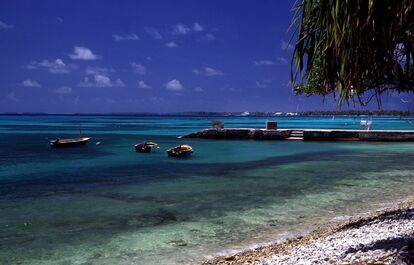
The news comes from the Pacific, but it speaks to the whole world. Tuvalu, one of the planet’s smallest island states, is progressively losing land due to sea-level rise. This isn’t a future projection: it’s a process already underway. High tides are flooding inhabited areas, saltwater is contaminating freshwater aquifers, and coastal erosion is shrinking territory that is already extremely limited.
In this context, more than a third of the population has applied to access a climate visa program to Australia, established under the bilateral Falepili Union agreement, explicitly designed to respond to the impacts of climate change.
The mechanism sets a limited annual intake, allocated through a random selection system, a true “climate lottery”, allowing selected Tuvaluan citizens to relocate legally to Australia with access to work, education, and services, without losing the legal and cultural bond with their country of origin.
A climate adaptation laboratory
Tuvalu is a microstate with an average elevation just over one meter above sea level. This geographic reality makes its atolls extremely vulnerable to rising oceans, an effect that, in the Pacific, is progressing faster than the global average.
But reducing this story to a simple “disappearing island” narrative would be misleading.
What is happening in Tuvalu is, first and foremost, a climate adaptation laboratory, where resilience is not a slogan, but a daily necessity.
In recent years, the country has launched a structured strategy that combines engineering solutions, ecosystem-based approaches, and strengthened social and institutional capacity.
The Tuvalu Coastal Adaptation Project, supported by the Green Climate Fund and international partners, aims to protect the most exposed areas through coastal defenses, engineered land raising, and the creation of new habitable surfaces designated for critical infrastructure.
In parallel, the fundamental role of natural ecosystems is being recognized: mangroves, coral reefs, and coastal vegetation are not simply features of the landscape, but genuine natural defenses against erosion and storm surges.
Alongside physical works, Tuvalu is investing in knowledge and skills. The use of satellite data, topographic surveys, and climate modeling enables targeted planning, while technical training programs aim to strengthen the autonomy of local communities. Adaptation, in this sense, is not only about infrastructure, but about the ability to read risk, anticipate it, and manage it.
When staying isn’t enough
There is, however, one aspect that makes Tuvalu an emblematic case: human mobility is being acknowledged as an integral part of the resilience strategy. The climate visa program to Australia is not an improvised flight, but a planned pathway that guarantees access to work, education, and services, while preserving dignity and rights.
It is a response that breaks with a common narrative, according to which adapting necessarily means staying. In some contexts, adapting can also mean moving, keeping cultural and social ties alive even as territory changes.
Tuvalu’s story forces us to rethink sustainability itself: not as a simple reduction of impacts, but as the capacity to accompany transformation, even when it calls borders, identity, and ways of life into question. In a world where more and more coastal communities will face similar risks, adaptation becomes a complex, multi-layered process: defend what can be defended, regenerate what can be regenerated, and when necessary rethink what it means to inhabit a place.
Tuvalu is not a distant exception. It is an early signal. And it reminds us that climate resilience is not made only of walls and barriers, but of political choices, international cooperation, and new forms of global solidarity.
Sostenibilmente in… : beyond the article, a technical lens and practical tools
If the article you’ve just read sparked an insight, you’ll find much more in the Sostenibilmente in… newsletter: a concise yet content-rich format, designed for those who want to stay up to date on sustainability and receive each issue in full, offering a broader perspective and practical takeaways you can apply in your day-to-day work.
The newsletter is curated by Beeability, Gesteco’s sustainability team.
Alongside the main feature, you’ll find additional “plus” content with a technical focus: implications, contextual interpretations, and useful connections to help you make sense of what is happening—not just read about it.
The “plus” sections you’ll find in Sostenibilmente in…
- Resonances: a visual prompt that adds perspective and depth, making the issue’s theme immediately tangible for the reader.
- To Listen: a space for a reflective pause, a curated musical reference that, in tone and meaning, echoes the key questions raised in the article and invites you to engage with the topic not only technically, but also through its emotional and cultural dimensions.
- The Noticeboard: an infographic tool that neatly curates useful resources related to the theme of the month, ideas to explore further, tools, initiatives, and selected content to consult, download, and share at work, at home, or at school.
If you’d like to receive the next issues with all sections and extra content, SUBSCRIBE TO THE SOSTENIBILMENTE IN… NEWSLETTER.