Sustainably in - 9 September 2026
The sky we helped heal
From the ozone hole to the Montreal Protocol and on to climate change: we look back at one of the most emblematic cases in which science became a matter of public concern.
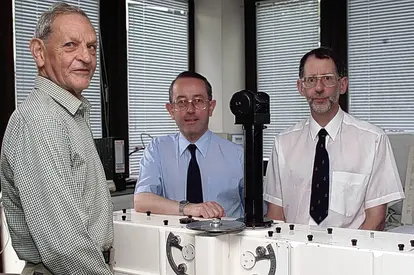
Joe Farman, Brian Gardiner and Jonathan Shanklin, the three British Antarctic Survey scientists who discovered the ozone hole in 1985 while working at the Halley Bay research station in Antarctica. Their instrument, a Dobson spectrophotometer in use since the 1950s, recorded values so low that Farman initially suspected a malfunction: he ordered a new instrument and waited a year before publishing the findings, to make sure the measurements were correct.
On 16 September 1987, the Montreal Protocol was adopted and opened for signature in Montreal. This international agreement marked the beginning of the gradual phase-out of substances responsible for depleting the ozone layer. It was the first environmental treaty in history to achieve universal ratification: every country in the world is now a party to it.
Concentrations of ozone-depleting substances in the Antarctic stratosphere have fallen significantly since peaking around 2000. According to the latest Scientific Assessment jointly conducted by WMO and UNEP, if current policies remain in place, the ozone layer is expected to return to 1980 levels by around 2045 over the Arctic and by 2066 over Antarctica.
The goal is still ahead of us, but the trajectory has been confirmed by nearly forty years of consistent data. It is one of the clearest examples of humanity identifying a global environmental problem, collectively deciding to tackle it and succeeding in reversing its course.
A problem that was, in some ways, tailor-made
Before drawing conclusions that are too broad, it is worth taking a closer look at why it worked.
Chlorofluorocarbons (CFCs) were produced by a relatively small number of major chemical companies, with DuPont among the world's leading manufacturers. When the scientific community demonstrated the link between these compounds and ozone depletion, the industry initially opposed restrictions. The position of some major producers began to shift as the threat became clearer and technological alternatives started to emerge. DuPont, which held a dominant position in the market, invested in developing substitutes and announced in 1988 that it intended to stop producing CFCs.
The concentration of the industry helped make this transformation more feasible: relatively few manufacturers, clearly defined industrial processes and chemical alternatives that could be developed and adopted. It was, of course, neither a simple transition nor one free from economic interests. But the combination of scientific pressure, international regulation and technological innovation made it possible to rapidly change the direction of an entire market.
Climate change has a very different architecture. Greenhouse gas emissions cut across every sector of the economy, every supply chain and the everyday choices of billions of people. There is no single substance to ban, nor just a handful of manufacturers to persuade. However tempting the comparison between the two challenges may be, it only goes so far.
When the problem becomes everyone's concern
There is, however, another, less technical factor that played an important role: the ability to turn a scientific issue into a public issue.
The ozone hole was an invisible phenomenon, difficult to perceive directly in everyday life. Scientific observations, satellite images and increasing media coverage helped make it tangible and understandable beyond the scientific community. An atmospheric threat became a visible, widely discussed issue that the general public could recognise and understand.
This growing attention helped generate political pressure for governments and businesses to act. Science had provided the evidence; society helped make that evidence increasingly difficult to ignore.
Data alone did not heal the sky. Binding international agreements, economic mechanisms, technology transfer, monitoring systems and the ability to update regulations as scientific knowledge evolved were all essential.
Perhaps this is the most interesting aspect of the Montreal Protocol story: science, public opinion, economics and institutions influenced one another until transformation became possible.
The solutions we already have
And yet, there is one element that the ozone challenge and the climate challenge have in common, and it is less obvious than it might seem: many of the solutions we need are already available.
In its 2023 Synthesis Report, the IPCC reiterated that technically feasible and effective mitigation options already exist to rapidly reduce emissions. Many can already be implemented and their impacts measured, across sectors ranging from energy and buildings to transport and industry. The main challenge lies in the speed and scale at which these solutions are adopted.
The story of ozone protection, after all, continued to evolve well beyond the 1987 Protocol. HFCs, introduced as substitutes for many CFCs, do not damage the ozone layer but are powerful greenhouse gases. In 2016, the Kigali Amendment therefore introduced a gradual phase-down of HFCs, demonstrating how an environmental agreement can evolve alongside scientific knowledge and in response to the effects of its own solutions.
Perhaps this is precisely where optimism, if it is to be useful, must remain grounded in reality: environmental problems have different characteristics, the solutions available vary from one sector to another, and transitions require different timelines, investments and tools.
The story of the ozone layer nevertheless remains proof that international cooperation, when it combines clear goals, shared data, public pressure, innovation and rules capable of evolving, can deliver tangible results.
The ozone trend is moving back towards the levels recorded four decades ago. It is a concrete achievement, built over time, and it points to a possibility: when society recognises a problem, has the knowledge needed to address it and creates the tools required to act, even a global environmental crisis can change course.matter of public concern.
Sostenibilmente in…: beyond the article, a technical lens and practical tools
If what you’ve just read has sparked a thought, you’ll find much more in the Sostenibilmente in… newsletter: a concise yet content-rich format designed for those who want to stay up to date on sustainability. Each month you’ll receive the full edition, with materials that broaden your perspective and practical tools you can bring into your day-to-day work.
The newsletter is curated by our sustainability team.
Alongside the main feature, you’ll find additional “plus” content with a technical focus: implications, contextual interpretations, and useful connections to help you make sense of what is happening, not just read about it.
If you’d like to receive the next issues with all sections and extra content, SUBSCRIBE TO THE SOSTENIBILMENTE IN… NEWSLETTER.
The “plus” sections you’ll find in Sostenibilmente in…
- Resonances: a visual prompt that adds perspective and depth, making the issue’s theme immediately tangible for the reader.
- To Listen: a space for a reflective pause, a curated musical reference that, in tone and meaning, echoes the key questions raised in the article and invites you to engage with the topic not only technically, but also through its emotional and cultural dimensions.
- The Noticeboard: an infographic tool that neatly curates useful resources related to the theme of the month, ideas to explore further, tools, initiatives, and selected content to consult, download, and share at work, at home, or at school.