Sustainably in - 17 April 2026
Without us
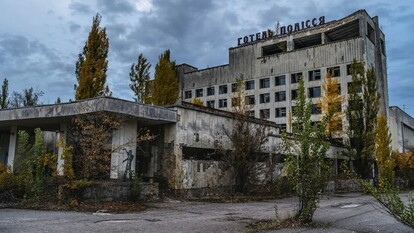
Hotel Polissya, Pripyat. The sign on the rooftop is still readable; in the meantime, the trees have decided for themselves where to grow.
On 26 April 1986, reactor number four at the Chernobyl nuclear power plant exploded in the middle of the night. In the hours that followed, a 30-kilometre zone around the plant was evacuated.
The city of Pripyat, built specifically for the plant’s workers and home to 50,000 people, was emptied the next day in less than three hours.
Many of the domestic and stray animals left behind were killed in an attempt to limit the spread of radioactive material to surrounding areas. The soil became laden with caesium-137 and strontium-90. The conifer forests closest to the plant turned red, then died: that stain has remained for decades like a mark, and is still known today as the Red Forest.
It was thought the area would be inaccessible for centuries. It didn’t turn out that way.
Forty years later, the Exclusion Zone is one of Europe’s largest rewilding “laboratories” and, if you consider together the Ukrainian and Belarusian protected areas, the third largest nature reserve in continental Europe. Not by choice, not by design: by absence.
Deer, wolves, lynx, European bison, Przewalski’s horses and more than two hundred bird species now live in what was meant to be a dead landscape.
Camera traps set by researchers have captured images of foxes posing on empty asphalt, lynx crossing the corridors of abandoned buildings, and moose walking among the remains of a playground.
The paradox within the paradox
In February 2022, the Chernobyl Exclusion Zone was caught up in the first stages of the invasion of Ukraine. For several days, the area remained under military control, disrupting monitoring activities and limiting researchers’ access.
The absence that had allowed nature to return was broken in the most unpredictable way.
And yet it is precisely this rupture that makes explicit what forty years of research had suggested quietly: it was not that species became stronger, it was human silence that made room for them.
The wolves did not “win” against radiation; they won against us, at the moment we were no longer there.
Forty years after Chernobyl, what remains is not only a warning about nuclear risk. It is a more uncomfortable question: if the necessary condition for an ecosystem’s resurgence is human absence, what does that say about the way we inhabit the planet?
Sostenibilmente in… : beyond the article, a technical lens and practical tools
If what you’ve just read has sparked a thought, you’ll find much more in the Sostenibilmente in… newsletter: a concise yet content-rich format designed for those who want to stay up to date on sustainability. Each month you’ll receive the full edition, with materials that broaden your perspective and practical tools you can bring into your day-to-day work.
The newsletter is curated by our sustainability team.
Alongside the main feature, you’ll find additional “plus” content with a technical focus: implications, contextual interpretations, and useful connections to help you make sense of what is happening—not just read about it.
The “plus” sections you’ll find in Sostenibilmente in…
- Resonances: a visual prompt that adds perspective and depth, making the issue’s theme immediately tangible for the reader.
- To Listen: a space for a reflective pause, a curated musical reference that, in tone and meaning, echoes the key questions raised in the article and invites you to engage with the topic not only technically, but also through its emotional and cultural dimensions.
- The Noticeboard: an infographic tool that neatly curates useful resources related to the theme of the month, ideas to explore further, tools, initiatives, and selected content to consult, download, and share at work, at home, or at school.
If you’d like to receive the next issues with all sections and extra content, SUBSCRIBE TO THE SOSTENIBILMENTE IN… NEWSLETTER.